







The K-pop music industry just blinked twice.
A single announcement sent shock throughout the K-pop industry, interrupting comeback plans and dividing a global fandom. What began as a year of ongoing legal wrangling over contracts and control suddenly transformed into one of the most dramatic pivots in modern K-pop culture: a member’s departure not through choice, but by the decision of the company behind her very own group.
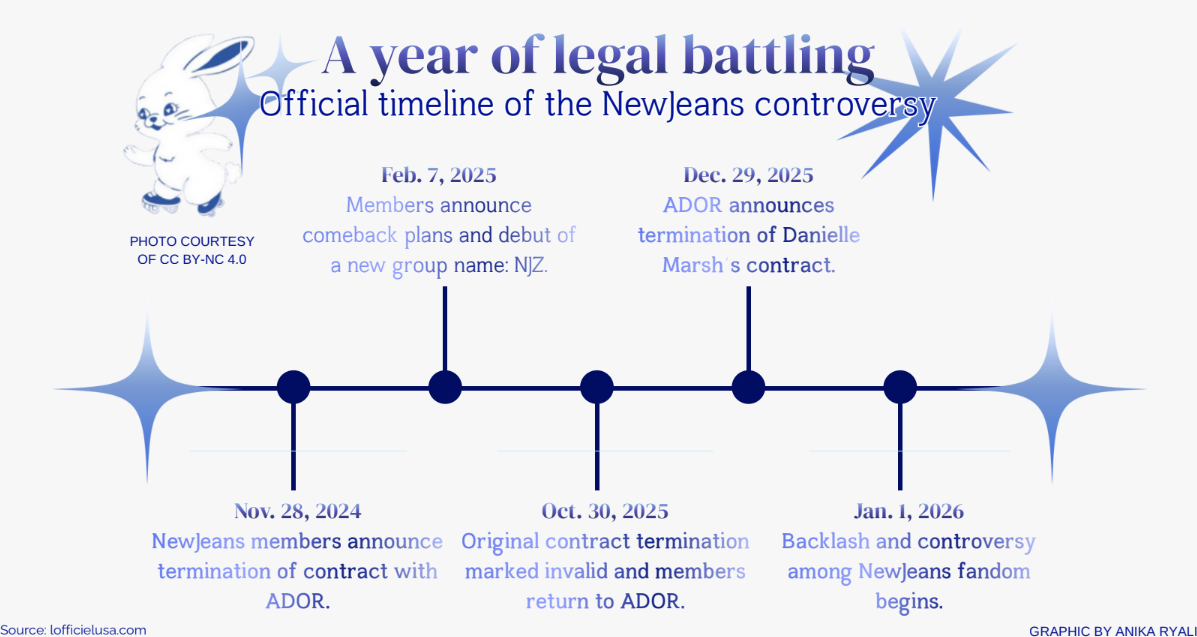
On Dec. 29, 2025, ADOR, the HYBE-owned management label behind NewJeans, a five-member South Korean girl group that debuted in 2022, announced that it had terminated the contract of 20–year–old member Danielle Marsh following a year of legal disputes and controversy over management and control between the NewJeans group. Specifically, Marsh was removed for allegedly signing independent contracts without ADOR’s approval and participating in unauthorized solo activities, according to forbes.com. Not only has her contract with ADOR been removed, but they revealed plans to pursue a lawsuit against Marsh for approximately $30 million USD, according to koreatimes.co.kr. The decision arrived as the group was preparing for a highly anticipated comeback, sparking both industry and fan reaction.
The move not only reshaped the future of NewJeans, whose comeback plans were already underway, but also sent shockwaves among fans, initiating debates about artistry, agency and the typically unseen tensions between idols and the labels that shape them.
“I remember when the NewJeans controversy started and how they disbanded for a while back in 2024 because they were my top artist on Spotify that year,” said WHS K-pop club member Ella Tucker ‘27. “Now that their comeback plans have been stopped, I think that because Danielle getting cut is getting more attention than what she actually did, there probably wasn’t enough justification to cut her contract short.”
Since their debut, NewJeans quickly became one of the most influential girl groups in K-pop, known for their Y2K inspired visuals and music as well as their strong international appeal. However, ongoing disputes between ADOR and Marsh have likely ended the possibility of NewJeans’ return as a five-member group. The loss has resonated among the NewJeans and K-pop fandom, prompting widespread discussion about artistry management and the rigid ways of the K-pop system that idols must experience after signing a contract with a label. Fan disappointment and anger have been especially directed at ADOR after their statement on the situation was released, as many hoped the ongoing legal conflict could be resolved peacefully on both ends.
“NewJeans is a very important group that changed the world of female K-pop acts,” said music critic Lim Hee-yun in an interview with bbc.com. “For the music listeners and fans, it has been the hope to see their return as a full five-member team. That’s no longer possible, and this new outcome isn’t making anyone happy.”
To address the speculation and intensifying resentment expressed by many fans towards ADOR for their recent actions, the company issued a public response, stating that the outcome was a result of accumulated legal issues caused by Marsh rather than a sudden termination on their end. The label also argued that Marsh’s actions had made it increasingly difficult to maintain trust and long-term planning within both the group and the company’s management structure. By presenting the situation as a necessary procedure due to the ongoing dispute, ADOR hoped to decrease backlash from fans and clarify why they must assert authority over artist contracts.
“We determined it would be difficult to continue with Marsh as a NewJeans member and ADOR artist and notified her today of the termination of the exclusive contract,” wrote NewJeans’ management company ADOR in their public statement according to koreatimes.co.kr.
While a vast majority of the NewJeans fandom and K-pop industry defend Marsh’s actions and hold disdain for ADOR’s legal choices, other fans take on a different perspective of the recent circumstances. Many fan reactions reflect a broader range of views, including outlooks that prioritize idol accountability over loyalty to individual members of the group. Some argue that the dispute is less about emotional attachment to and more about professional responsibility, with an emphasis on the expectation that idols must adhere to the terms they sign.
“I think Danielle messed up,” said WHS K-pop club member Alina Georgescu ‘29. “I like NewJeans, and I know Danielle has a bunch of fans. But a contract is a contract, and she went against the rules that were in it. Also, she’s 20 years old and definitely knows what the consequences are for what she did.”
As responses and reactions circulate, the continuing NewJeans controversy has drawn attention to how K-pop groups are governed and managed by their labels and how legal conflicts are handled within the industry. The situation has launched discourse about idol autonomy, the balance of power within contracts and how similar issues are communicated to the public.
“This practice reflects the highly centralized nature of the K-pop system,” said Ray Seol, K-pop industry expert at Berklee College of Music in an interview with nytimes.com, “in which agencies tightly control branding, messaging and media access.”