

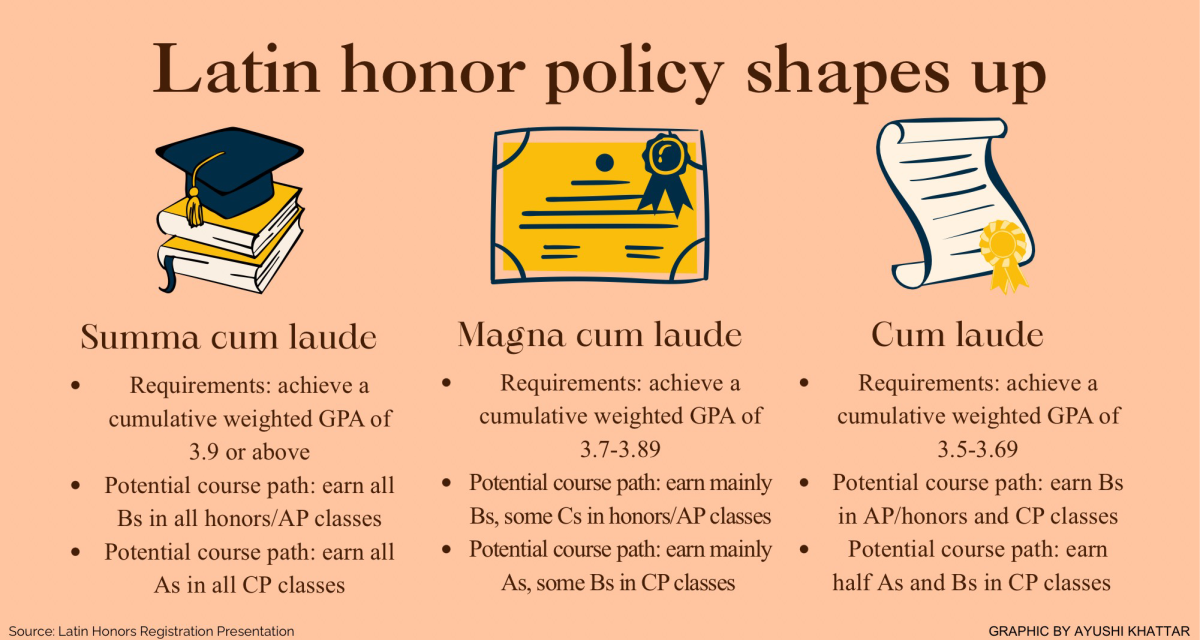













Beginning with the WHS class of 2028, students will no longer be recognized as valedictorians based on their indexed GPAs. Instead, students will have the opportunity to be honored with one of three Latin honors based on their cumulative weighted GPAs: summa cum laude for a weighted GPA of 3.9 or above, magna cum laude for 3.7–3.89 or cum laude for 3.5–3.69.
“I think we’ve [seen], since the first time I started working here, a lot of tears from students and parents that were close to making the mark and didn’t, or were really stressed out because they had kind of overextended themselves trying to earn those additional indexed GPA,” said Emily Nelson, junior and senior counselor who proposed the policy change after researching impacts of the current valedictorian policy. “Over the last few years, it’s been pretty obvious that this [current policy] is not working.”
From college admissions officers not being able to properly gauge student achievement from WHS’s current valedictorian policy, to lack of inclusion, to keeping students from exploring career pathways, it is clear that many reasons have prompted this change. The new policy has been evaluated and accepted at the district level by the Board of Education and the Student District Advisory Council, and it will be integrated at all CVUSD high schools, according to Nelson.
“For our students that are going to be exclusively in special education [courses] or CP [courses], they do have to still earn a 3.9, which is an almost flawless GPA in order to get that summa cum laude,” said Nelson. “We have seen that a very specific set of coursework was always leading to the valedictorian [title]: students in our chamber orchestra program, but not in our ROP classes or our child development pathway, for example. … [Now, we can honor students based on] relative strength.”
However, there are concerns that this new policy contradicts the intent of any honor policy: to acknowledge the highest–achieving students in a graduating class. Some people worry that in an effort to be more inclusive, the new awards will lack true value and not act as something students are genuinely interested in working towards.
“Lowering [the GPA cutoff] to 3.9, even for the highest level, and 3.5 to lowest level, where over half of your graduating class is going to get the highest level of academic recognition, is turning something that was initially meant to be a reward for excellence to outstanding students into something that’s more focused on inclusion and becoming a participation trophy,” said Kimi Basamakov ‘26. “The idea is not bad, but putting it so that such a large category of your student body is getting the highest level of academic recognition is not going to be successful in motivating students.”
The goal of the policy is to reward students for working as hard as they can without reaching a point of debilitating stress, and many do feel that this goal will come to fruition. The new awards seem more achievable, and the idea of having an honor more in reach is actually more motivating for some.
“In terms of GPA, … having … larger increments of honors, you can still kind of fight to claim those honors, and it’s not necessarily reserved to those top 30 students,” said Luna Garcia ‘28. “Someone who gets [magna cum laude] can still feel rewarded for getting [magna]. There are still levels of stuff you can work for in this sense. … I think for me, especially, I think there’s more motivation now that I don’t have to be absolutely perfect and break my back to do … excellent in all of my classes.”
Critics of the old policy stated that there were simply too many students being awarded valedictorian to the point where that title was “diluted,” according to Nelson. On the other hand, with different grading policies in effect across WHS classes and the rise in accommodating grading or grade inflation, the new policy may backfire as more people will earn the new academic awards.
“Because there’s such an emphasis on grades and having a high GPA, teachers are seeing the stress that creates in students to try and get higher grades and [try to] succeed,” said Basamakov. “As a result, teachers are changing policies, adapting and not standardizing. …That results in more students getting As than should be getting As, and as a result, en masse, your average GPA will be higher. … You’re going to have more people earning the valedictorian awards or earning the cum laude awards once they’re in effect.”
Overall, the shift in award policies reflects a shift in values at schools. Education as a whole is moving towards prioritizing effort, inclusion and healthy, individual challenges where students push themselves without self–detriment. Schools may look forward to rewarding children for truly immersing themselves in learning and growth, although those may be more abstract concepts to gauge.
“I feel [that] grades in high school … do definitely matter for college applications, but aside from that, I really want to focus on what I will [learn] outside of college,” said Garcia. “There is importance to [succeeding academically], and I do want to get good grades in my class, but obviously, I want to retain the information, especially when it’s valuable to me and what I’m interested in.”



Max • Feb 26, 2026 at 12:10 pm
This change is ridiculous. I have been a Westlake High School parent for five years now (two children), and I have watched the school repeatedly reduce its emphasis on academics in our time here. If I had to do it again, I don’t think I would send my children here.
Jack • Mar 9, 2026 at 12:12 pm
Hear hear!