
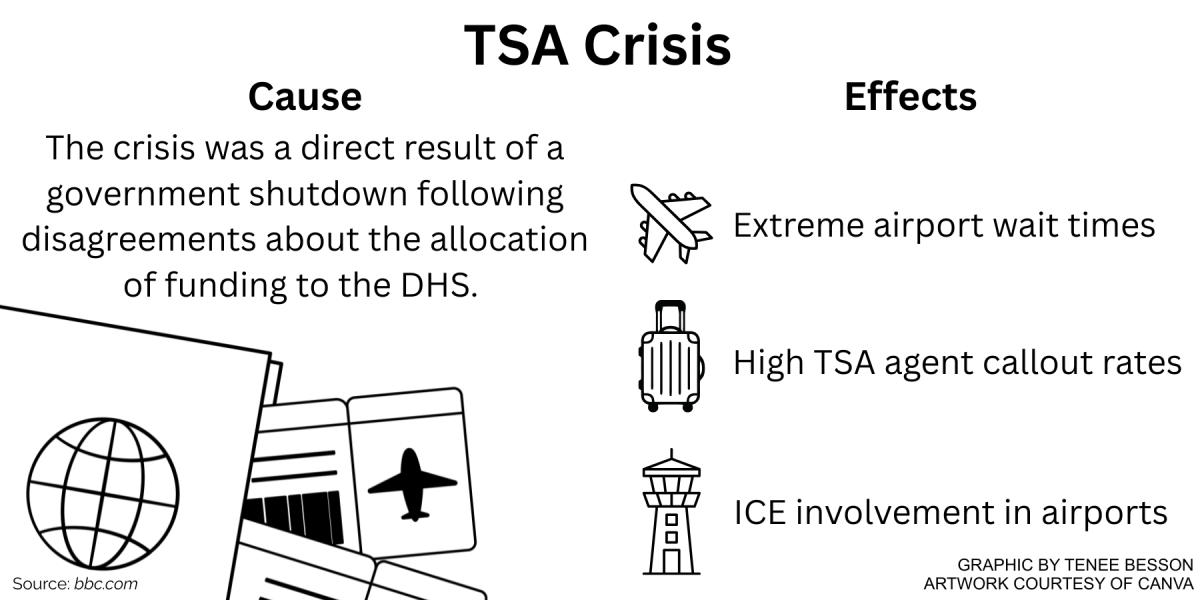



















On February 14, 2026, tens of thousands of Transportation Security Administration employees were left without pay following disagreements about funding for the Department of Homeland Security. This period marked the start of the longest partial government shutdown in US history.
The DHS encompasses a variety of government organizations, including the TSA, the Federal Emergency Management Agency and several immigration agencies. During Congressional discussions that began in early 2026, Democrats opposed departmental funding without reforms, such as banning ICE agents from wearing masks and allegedly engaging in racial profiling. However, Republicans asserted that proper funding for immigration enforcement, along with requirements for voter ID, was necessary to garner their support for any legislation, according to bbc.com.
“I think [ICE has] more than enough money,” said Rishi Sikh ‘28. “If anything, we should be looking at the priorities of ICE and the way that they’re achieving their missions and ideals.”
As a result of the stalemate in Congress and the subsequent funding deficit, nearly 500 TSA agents have quit since the beginning of the shutdown. Additionally, some airports have experienced daily TSA officer call–out rates of as high as 40%. The staffing shortages resulted in extreme wait times, some lasting for several hours, prompting airports to urge fliers to arrive several hours in advance, according to pbs.org.
To counter the nationwide rise in TSA callouts, President Trump deployed Immigration and Customs Enforcement agents to several major airports around the country, including Cleveland Hopkins International Airport and New York’s LaGuardia Airport. ICE agents were initially authorized to question, search and arrest those they believed to be undocumented immigrants without a warrant. Recently, however, ICE agents have been utilized in airports to aid TSA agents by “guarding entrances and exits, assisting with logistics, doing crowd control and verifying identification using TSA equipment and standard operating procedures,” according to acting assistant secretary Lauren Bis in an interview with npr.org.
“ICE is there to help our brothers and sisters in TSA,” said White House border czar Tom Homan, who oversees border security and immigration, in an interview with cbs.org. “We’ll be there as long as they need us, until they get back to normal operations and feel like those airports are secure.”
ICE agents will still be engaged in immigration enforcement while simultaneously performing security–related jobs at airports, according to npr.org.
“I think that [immigration enforcement] and our Border Patrol [are] very important and the best way to make sure that there are some people who are here the right way is by enforcing the regulations,” said Jaclyn McGray ‘26.
On March 27, 2026, President Trump signed an emergency directive that ordered TSA agents to be paid despite Congress’s failure to end the shutdown. According to the DHS, most TSA agents accepted a retroactive paycheck on March 30, which included a minimum of two full two–week paychecks, while thousands of other DHS workers were scheduled to receive their earnings between April 10 and April 16, according to reuters.com and nytimes.com.
Homeland Security Secretary Markwayne Mullin recently reported that the DHS will be unable to provide TSA workers’ salaries the first week of May due to financial strains, according to politico.com.
“My payroll through DHS is just over $1.6 billion every two weeks, so the money is going extremely fast, and, once that happens, there [are] no emergency funds after that,” said Mullin on “Fox and Friends,” according to politico.com. “I’ve got one payroll left, and there [are] no more emergency funds, so the president can’t do an executive order because there’s no money there.”