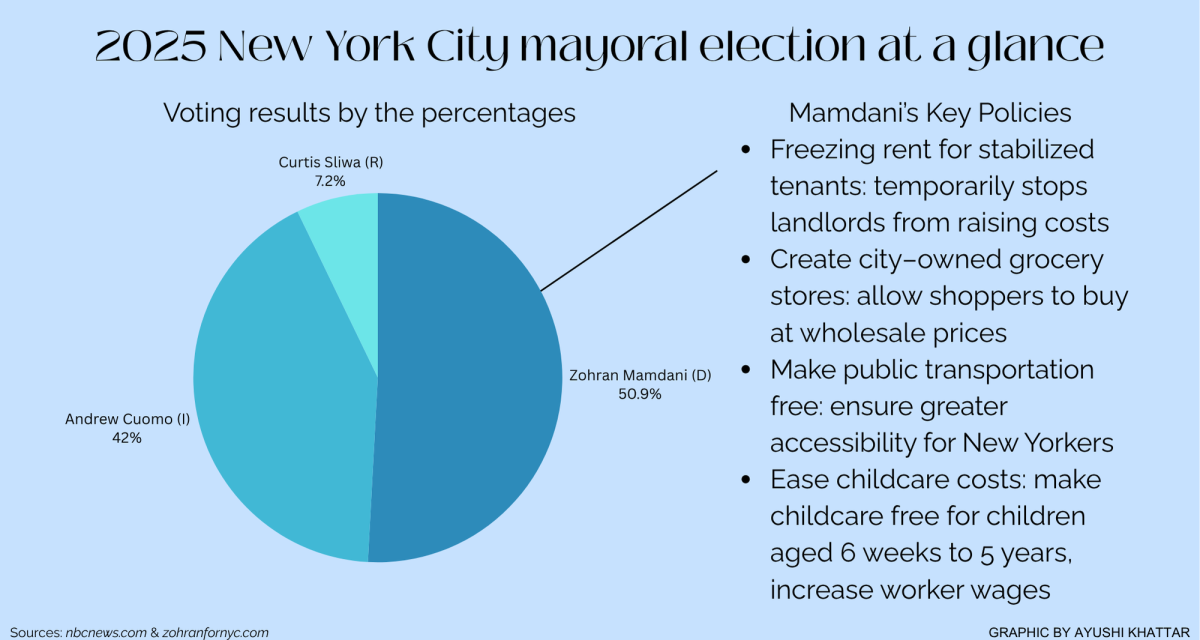





On Nov. 4, 2025, Democrat Zohran Mamdani became mayor of New York City, carrying over one million votes in his favor. Previously a New York state assemblyman, Mamdani ran against Andrew Cuomo, Independent and former governor of New York, and Curtis Sliwa, Republican and 2021 NYC mayoral candidate. Following extensive efforts to connect with voters of all ages and tough competition specifically against Cuomo, Mamdani, a democratic socialist, won over NYC.
“If Sliwa had dropped out of the race, … the margin would have been so much tighter, and Cuomo could have won,” said Izzy Beller ‘29, Teens for Democracy club member. “When Cuomo was governor of New York, he didn’t really do good for the state. I think that people elected Mamdani because America has just been all [about] capitalism, and they wanted the new ideas.”
Mamdani is the first Muslim–American and Indian mayor of NYC, and he’s also the youngest mayor since 1892, according to fortune.com. Mamdani tapped into his youthfulness through the use of social media campaigning, which encouraged many Generation Z voters to favor him and even spread his campaign on their own. In his former position, he was the first South Asian assemblyman to serve the state, and that encouraged him to ensure all New Yorkers had their voices heard, access to housing with fair rent and clean air, according to nyassembly.gov.
“I think having such a young and fresh perspective is very exciting, especially for such a major city,” said Savannah Southwood ‘26, Contemporary World Issues Honors student. “I think it’s very hopeful to have an immigrant represent the party. It’s very inspiring, [and] it implies unity in the party. We can all kind of rally around one person.”
When it comes to his promises, Mamdani has advertised free bus transportation, cost–free childcare, raising the minimum wage in the city to $30 by 2030, temporarily freezing rent rates and creating city–owned grocery stores, according to zohranfornyc.com. While he has only recently been elected, many are intrigued to see how such plans will actually come to fruition.
“Raising taxes and free buses [are] not necessary,” said Oliver Gaines ‘29, Teens for Democracy club member. “That can be taken advantage of. … I’m [also] very curious [about] the freezing rents. Especially for landlords and everybody else, [I wonder] how they will get their money, how it’s going to affect them and how it may bring [the] homeless into housing as well.”
Mamdani is specifically a democratic socialist. A core concept in this ideology is the support of “the government taking control over certain sectors of the economy, such as healthcare and utilities, to benefit the public rather than private corporations,” according to npr.org. Many voters felt contention over the belief that democratic socialism could parallel many of the negative impacts of socialism — even communism — that were characteristic of World War II.
“Democratic socialism is … a lot more complicated than [communism],” said Beller. “It’s government overreach, but the power is still with the people. The people control everything, but the government is making sure that everything is running smoothly. The problem is [that democratic socialism] is just painted as communism. [But,] a lot of countries in Europe are democratic socialists, and [those countries] have some of the strongest economies in the world.”
With the ideology’s focus on public welfare, great funding is necessary to bring these large–scale projects to life. Mamdani has stated that he intends to increase the corporate tax rate to 11.5% from the current 6.5–7.25% and to tax the wealthiest 1% of New Yorkers at a flat rate of 2%, according to zohranfornyc.com. Some fear that such projects will ultimately hurt the people who need help.
“I’m a little worried,” said Austin Kelly ‘27, Contemporary World Issues Honors student. “All these socialist ideas, [they] never work in America. I think a lot of individuals who voted for him are on the poor end, and they don’t realize that … all these billionaires that live in New York [who will get heavily taxed] are just going to leave, and [the financial pressure is] going to end up on … the poor people.”
There is a great concern that Mamdani’s implementation of democratic socialism could negatively impact the way the Democratic Party as a whole is viewed in the United States. If Mamdani doesn’t succeed in NYC, the party, at a national level, may be chastised and further divided in future elections as they had been throughout the 2024 election, according to Kelly.
“Do I think that democratic socialism is gonna be the ideology of the United States?” said Beller. “No. But do I think that this could be a big step for the Democratic Party as a whole? Yeah. I mean midterms are coming up, and the [2025] elections overall, not even just the mayoral election, was a blue sweep. I think it really just depends on how Mamdani does as mayor. … It’s kind of just a lot of speculation [right now].”
Still, the 2025 NYC mayoral election was a historical one; it was the first election since 1969 to see a voter turnout of two million, according to thecity.nyc. At this point, only time can tell whether this election will impact the strength and perception of the Democratic Party, but many have hope given Mamdani’s personability and unique output.
“I think now that he’s had such a big success, I think other people will kind of be encouraged to speak up in similar views or similarly radical views,” said Southwood. “I think maybe our other leaders can kind of join forces.”